As an Amazon Associate, Home of a Book Lover earns from qualifying purchases. Book data from Open Library.

Daniel Kahneman's 2011 book is unusual twice over: it is a popular science book written by the researcher who produced much of the evidence, and it ties judgment, risky choice and well-being together under one image, the fast System 1 and the slow System 2. So instead of listing anything with "bias" in the blurb, this guide asks what each candidate shares with Kahneman's book and where it parts company.
The eight picks fall into three loose families. Some tell the story behind the research (The Undoing Project, Misbehaving). Some extend the science in a new direction (Noise, Nudge, Predictably Irrational). And some carry the ideas into a specific arena of everyday life: poker-style decisions, persuasion and money (Thinking in Bets, Influence, The Psychology of Money).
What readers value in Thinking, Fast and Slow
- Primary-source authority. Kahneman explains his own experiments and reprints two of the papers he wrote with Amos Tversky.
- A memorable framework. System 1 and System 2 give readers a vocabulary they can reuse.
- Breadth. Anchoring, availability, overconfidence, prospect theory and the remembering self all sit in one volume.
- Candour about error. After the priming chapter was challenged in 2017, Kahneman publicly said he had placed too much faith in underpowered studies, which is a useful habit to look for in any follow-up read.
How we matched these books
- Deals with how people judge, choose or decide, not only with motivation or productivity
- Connects directly to the Kahneman–Tversky research program or the behavioral economics built on it
- Written by a researcher in the field, or by a writer whose subject is that research or its application
- Known evidence problems are flagged on this page rather than left out
8 books like Thinking, Fast and Slow
The Undoing Project
A Friendship That Changed Our Minds
- Why it matches
- Michael Lewis's subject is the partnership that produced most of the ideas in Thinking, Fast and Slow: Kahneman and Tversky, from their first collaboration in 1969 to the falling-out that ended it.
- Key difference
- It is a narrative of two people rather than an explanation of findings; reviewers noted that the research is covered almost in passing.
- Best for
- Readers who finished Kahneman wanting to know who these scientists were.
Noise
A Flaw in Human Judgment
- Why it matches
- Kahneman's own sequel, written with Olivier Sibony and Cass Sunstein, keeps the focus on professional judgment.
- Key difference
- Where the 2011 book is about bias, error in one direction, Noise is about unwanted scatter: underwriters pricing identical cases a median 55 percent apart, for example. It is also more organizational, prescribing noise audits and decision hygiene.
- Best for
- Managers, clinicians and anyone who reviews other people's judgments.
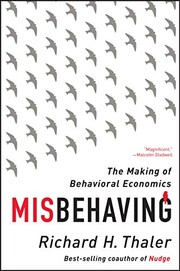
Misbehaving
The Making of Behavioral Economics
- Why it matches
- Richard Thaler is the economist who carried Kahneman and Tversky's psychology into economics, and Kahneman credited his 1980 paper on consumer choice as a founding text of behavioral economics.
- Key difference
- It is an insider's memoir of the economics profession's resistance, with examples from the NFL draft, game shows and Uber pricing, rather than a survey of cognitive mechanisms.
- Best for
- Readers who want the economics side of the story, told with humor.
Nudge
Improving Decisions About Health, Wealth, and Happiness
- Why it matches
- Nudge starts from the same premise, that people are not the rational homo economicus of textbooks, and asks what follows for anyone who designs choices.
- Key difference
- It is prescriptive and policy-minded: choice architecture, defaults and libertarian paternalism. Its effect sizes are now debated; a 2022 reanalysis found no evidence for nudging overall once publication bias was adjusted for.
- Best for
- Readers in policy, HR, product design or public health.
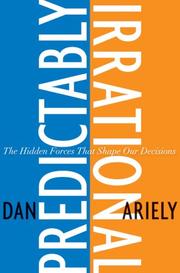
Predictably Irrational
The Hidden Forces That Shape Our Decisions
- Why it matches
- Dan Ariely also argues that errors are systematic rather than random, using experiments on anchoring-style arbitrary prices, decoys and the pull of "free."
- Key difference
- It is lighter, built almost entirely from short experiment stories. Read it with the record in mind: a 2012 PNAS paper Ariely co-authored was retracted in 2021 over evidence of fabricated data. That paper post-dates the book, but further retractions and replication failures have followed.
- Best for
- A quick, approachable second book, read critically.
Thinking in Bets
Making Smarter Decisions When You Don't Have All the Facts
- Why it matches
- Annie Duke tackles Kahneman's theme of judgment under uncertainty, asking how to separate the quality of a decision from the luck of its outcome.
- Key difference
- She writes as a former professional poker player and practitioner, not a researcher, and she focuses on habits such as treating beliefs as bets and building truth-seeking groups.
- Best for
- Investors, managers and anyone who reviews decisions after the fact.
Influence
The Psychology of Persuasion
- Why it matches
- Cialdini studies the same fast, automatic shortcuts that System 1 relies on.
- Key difference
- His angle is how others exploit those shortcuts: reciprocation, commitment, social proof, liking, authority and scarcity, much of it drawn from three years undercover in sales and fund-raising.
- Best for
- Marketers, negotiators and anyone who wants to spot persuasion tactics.

The Psychology of Money
Timeless Lessons on Wealth, Greed, and Happiness
- Why it matches
- Morgan Housel applies the behavioral view, that outcomes depend on how people behave more than on what they know, to saving and investing.
- Key difference
- It cites no experiments; it is 19 short stories with almost no math, so it reads as reflection rather than science.
- Best for
- Readers who want behavioral ideas in their personal finances.





Side-by-side comparison
| Book | Relationship to Kahneman | Written by | Mode | Pages (listed edition) | Evidence note |
|---|---|---|---|---|---|
| Thinking, Fast and Slow | Seed book | Researcher | Science synthesis | 499 | Priming chapter weakly replicated |
| The Undoing Project | Biography of the collaboration | Journalist | Narrative | 368 | — |
| Noise | Co-authored sequel | Researchers | Science + organizational tools | 464 | Novelty of concept debated |
| Misbehaving | Economics counterpart | Researcher | Memoir / history | 432 | — |
| Nudge | Policy application | Researchers | Prescriptive | 304 | Effect sizes contested (2022) |
| Predictably Irrational | Parallel experiments | Researcher | Experiment stories | 304 | Author's later work retracted (2021) |
| Thinking in Bets | Uncertainty in practice | Practitioner | Practical | 276 | Synthesis, not new research |
| Influence | Shortcuts exploited by persuaders | Researcher | Science + fieldwork | 336 | — |
| The Psychology of Money | Behavior applied to money | Writer / investor | Essays | 256 | Stories, not studies |
Pick by what you want
- the human story behind the research The Undoing Project
- Kahneman's own next step Noise
- behavioral economics from an insider Misbehaving
- a decision tool you can use this week Thinking in Bets
- defence against sales pressure Influence
- a gentle, non-technical read The Psychology of Money
Keep exploring
FAQs
What should I read right after Thinking, Fast and Slow?
It depends on what held your attention. If it was the people, choose The Undoing Project; if it was the science of judgment, Noise continues Kahneman's own line of work.
Is Thinking, Fast and Slow still reliable given the replication crisis?
Mostly, with one clear exception. A 2017 analysis judged the social-priming studies in chapter 4 weak, and Kahneman agreed. Prospect theory and the heuristics-and-biases program rest on a different, much larger body of evidence, though a 2020 review urged caution across several chapters.
Is Predictably Irrational safe to recommend?
As an introduction to the style of experiments, yes, with a caveat. Data Colada found strong evidence of fabricated data in a 2012 paper Ariely co-authored, which PNAS retracted in September 2021, and further problems followed, so check any single finding before relying on it.
Sources & attribution
- Thinking, Fast and Slow: 2011; System 1/System 2; work with Tversky; FSG edition 499 pages — en.wikipedia.org
- TF&S edition record, appendices reprint Kahneman–Tversky papers — openlibrary.org
- Priming studies in chapter 4 weakly supported (2017 analysis) — replicationindex.com
- Kahneman: placed too much faith in underpowered studies — retractionwatch.com
- 2020 meta-scientific review of the whole book — replicationindex.com
- Undoing Project: Kahneman–Tversky partnership and how it broke apart; research 'almost in passing' — en.wikipedia.org
- Collaboration began 1969; Kahneman on Thaler's 1980 paper as founding text of behavioral economics — en.wikipedia.org
- Noise: co-authors, undesirable variability, underwriters median 55%, noise audits and decision hygiene; novelty questioned — en.wikipedia.org
- Noise 464 pages — hachettebookgroup.com
- Misbehaving: household finance, TV shows, NFL draft, Uber; builds on Nudge — en.wikipedia.org
- Nudge: choice architecture, libertarian paternalism, homo economicus — en.wikipedia.org
- 2022 reanalysis: no evidence for nudging after adjusting for publication bias — pubmed.ncbi.nlm.nih.gov
- Predictably Irrational: systematic errors, decoy effect, arbitrary prices, zero cost — en.wikipedia.org
- Data Colada: evidence of fabricated data in 2012 PNAS paper — datacolada.org
- PNAS retraction September 2021 — pubmed.ncbi.nlm.nih.gov
- Ariely: further retractions, expressions of concern — en.wikipedia.org
- Thinking in Bets: Duke former poker player; decisions vs outcomes; beliefs as bets — penguinrandomhouse.com
- Influence: principles; three years undercover — en.wikipedia.org
- Psychology of Money: 19 short stories; behavior over knowledge — harriman-house.com
- Page counts per verified editions (Open Library) — openlibrary.org
Book data from Open Library.