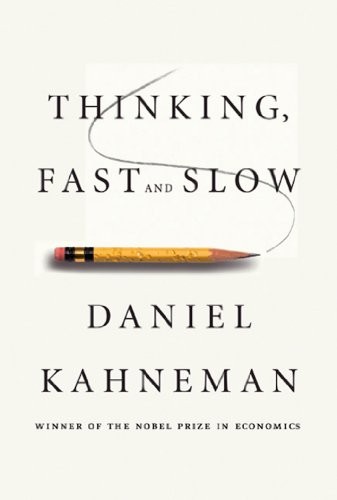
by Daniel Kahneman
- Thought and Thinking
- Decision Making
- Intuition
- Reasoning
As an Amazon Associate, Home of a Book Lover earns from qualifying purchases. Book data from Open Library.
Quick facts
| Author | Daniel Kahneman |
|---|---|
| First published | 2011 |
| Edition publisher | Farrar, Straus and Giroux |
| Edition date | 2011 |
| Language | English |
| Pages (this edition) | 499 |
| ISBN-13 | 9780374275631 |
| ISBN-10 | 0374275637 |
| Formats | hardcover |
| Subjects | Thought and Thinking, Decision Making, Intuition, Reasoning |
About Thinking, Fast and Slow
Daniel Kahneman's 2011 book gathers decades of research on judgment and choice into one argument: the mind runs on two modes of thought. "System 1" works fast, automatically and emotionally; "System 2" is slow, effortful and deliberate. Most of the book shows what happens when the quick system answers a question the careful one should have handled, from anchoring on irrelevant numbers to swapping a hard question for an easier one. Much of the underlying work was done with the psychologist Amos Tversky, and the research it summarizes is the body of work behind Kahneman's 2002 Nobel Memorial Prize in Economic Sciences.
Main themes
- Two systems of thought and how they hand work to each other
- Heuristics and biases: anchoring, availability, the conjunction fallacy
- Overconfidence and the illusion of understanding the past
- Prospect theory and loss aversion in risky choices
- Two selves: the experiencing self versus the remembering self
Key concepts
- System 1 and System 2
- WYSIATI (what you see is all there is)
- anchoring
- availability heuristic
- planning fallacy
- loss aversion
- prospect theory
- peak–end rule / remembering self
Who it’s for
Who should read it
Readers who want the source text behind most popular writing on cognitive bias, and professionals whose work involves forecasts, hiring, investing or any judgment made under uncertainty.
Who may not enjoy it
Anyone looking for a short, step-by-step self-improvement plan. The book diagnoses errors far more than it prescribes routines, and it runs to roughly 500 pages including notes and two reprinted academic papers.
What makes it distinctive
It is written by the researcher who produced much of the evidence, not by a journalist summarizing it, and it closes by reprinting the two landmark Kahneman–Tversky papers as appendices, so readers can move from the popular account to the original science.
Style & difficulty
Moderate to demanding. Thirty-eight short chapters in five parts keep the pace manageable, but the later sections on prospect theory and well-being ask for close attention.
Context
Kahneman shared the 2002 Nobel Memorial Prize in Economic Sciences for integrating psychological research into economics. The book received the 2011 Los Angeles Times Book Prize (Current Interest) and the National Academies Communication Award in 2012. It has since drawn scrutiny during psychology's replication crisis: a 2017 analysis of the priming studies cited in chapter 4 judged their evidence weak, and Kahneman replied publicly that he had "placed too much faith in underpowered studies." He had already urged priming researchers in a 2012 open letter to replicate their findings.
Strengths & limitations
Strengths
- Written by the scientist behind the research, with original papers reprinted in full
- Covers judgment, risky choice and happiness research in one framework
- Short, self-contained chapters that work as a reference
Limitations
- Some cited findings, especially the social-priming studies in chapter 4, have not held up well in later replication work
- Long and occasionally technical for a general reader
- Explains biases more than it offers practical ways to correct them
Similar books



FAQs
Do the replication problems undermine the whole book?
No. The criticism has focused on specific chapters, above all the priming studies in chapter 4, which Kahneman himself acknowledged relied on underpowered research. Core results such as prospect theory and the heuristics-and-biases program come from a different and far larger body of work, though a later replicability review argued for caution across several chapters.
Is there a follow-up book?
Kahneman co-wrote Noise: A Flaw in Human Judgment (2021) with Olivier Sibony and Cass Sunstein, which shifts the focus from systematic bias to random variability in professional judgments.
Sources & attribution
- Edition: FSG 2011 first edition hardcover, ISBN 0374275637 / 9780374275631, 499 pages; table of contents with five parts, 38 chapters, appendices A and B — openlibrary.org
- 2011 popular-science book; System 1 fast/instinctive/emotional vs System 2 slower/deliberative/logical — en.wikipedia.org
- Much research done in collaboration with Amos Tversky — en.wikipedia.org
- Kahneman awarded 2002 Nobel Memorial Prize in Economic Sciences for integrating psychological research into economic science — nobelprize.org
- 2011 Los Angeles Times Book Prize (Current Interest); National Academies Communication Award 2012 — en.wikipedia.org
- 2017 R-Index analysis of priming studies cited in chapter 4 found low replicability — replicationindex.com
- Kahneman: "I placed too much faith in underpowered studies" — retractionwatch.com
- Kahneman's 2012 open letter urging priming researchers to replicate — nature.com
- Later meta-scientific review of the whole book urging caution — replicationindex.com
- Noise (2021) co-written with Olivier Sibony and Cass Sunstein — en.wikipedia.org
- Cover image matches this work (visually checked) — covers.openlibrary.org
Book data from Open Library.
Listen: find the audiobook As an Amazon Associate we earn from qualifying purchases.