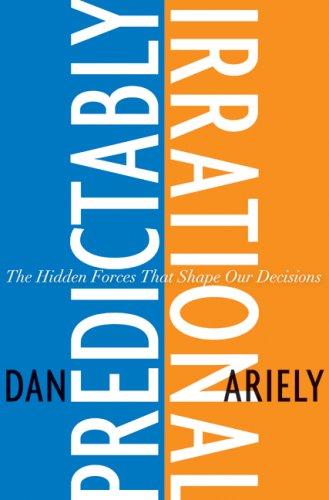
The Hidden Forces That Shape Our Decisions
by Dan Ariely
- Economics -- Psychological Aspects
- Decision Making
- Social Psychology
As an Amazon Associate, Home of a Book Lover earns from qualifying purchases. Book data from Open Library.
Quick facts
| Subtitle | The Hidden Forces That Shape Our Decisions |
|---|---|
| Author | Dan Ariely |
| First published | 2008 |
| Edition publisher | HarperCollins |
| Edition date | February 19, 2008 |
| Language | English |
| Pages (this edition) | 304 |
| ISBN-13 | 9780061353239 |
| ISBN-10 | 006135323X |
| Formats | hardcover |
| Subjects | Economics -- Psychological Aspects, Decision Making, Social Psychology |
About Predictably Irrational
Dan Ariely's 2008 book challenges the idea that people make decisions by rational calculation, arguing instead that our mistakes are systematic and therefore predictable. Each chapter is built around experiments, many run by Ariely and his collaborators, on a different distortion: how we judge options relative to whatever is nearby (including the decoy effect), how arbitrary reference points can set what we think something is worth, why "free" pulls so hard, how social norms and market norms clash, and how emotional arousal and procrastination override good intentions.
Main themes
- Relativity and the decoy effect
- Arbitrary pricing and the pull of "free"
- Social versus market norms
- Self-control and procrastination
Key concepts
- relativity
- decoy (asymmetric dominance) effect
- arbitrary pricing
- the cost of zero cost
- social norms vs. market norms
- hot and cool states
- procrastination and deadlines
Who it’s for
Who should read it
Readers new to behavioral economics who want an entertaining, experiment-led introduction, and marketers or product designers interested in how choices are framed.
Who may not enjoy it
Readers who want only findings that have stood up to later replication should approach it with care, given serious questions about parts of the author's later research record.
What makes it distinctive
It is built almost entirely around experiments described as small stories, which makes it one of the most approachable entries in the genre.
Style & difficulty
Easy. Light, anecdotal and quick to read.
Context
Ariely, a professor at Duke University, later published a revised and expanded edition, and the book inspired the 2023 NBC series The Irrational. Since 2021 his research has faced serious scrutiny: a 2012 PNAS paper he co-authored was retracted in 2021 after analysts found strong evidence that data in its insurance field experiment were fabricated, and further retractions, expressions of concern and replication failures have followed. That paper post-dates this book, but readers should weigh individual findings with that history in mind.
Strengths & limitations
Strengths
- Very accessible introduction to behavioral economics
- Memorable experiments and everyday examples
- Useful for anyone who sets prices or designs choices
Limitations
- The author's research record has been called into question since 2021
- Light on how findings fared in later replication
Similar books
Featured in
FAQs
Is Predictably Irrational still reliable?
Treat it as an introduction rather than a final word. The retracted 2012 paper is not part of this 2008 book, but questions about Ariely's later work and several replication failures are reasons to check key findings against newer sources such as Thinking, Fast and Slow or Misbehaving.
Sources & attribution
- Edition: HarperCollins hardcover, February 19, 2008, ISBN 006135323X / 9780061353239, 304 pages — openlibrary.org
- 2008 book challenging rational decision assumption; chapter topics: relativity/decoy effect, fallacy of supply and demand (arbitrary pricing), cost of zero cost, social vs market norms, emotion/arousal, procrastination and self-control (hot/cool states, deadlines); revised & expanded edition; adapted as 2023 series The Irrational — en.wikipedia.org
- Ariely professor at Duke; since 2021 accuracy of studies questioned with two retractions, expressions of concern, replication failures — en.wikipedia.org
- Data Colada [98]: strong evidence that insurance field experiment data in 2012 PNAS paper (Shu, Mazar, Gino, Ariely, Bazerman) were fabricated — datacolada.org
- PNAS retraction of Shu et al. 2012, published September 2021 — pubmed.ncbi.nlm.nih.gov
- Cover image matches edition (visually checked) — covers.openlibrary.org
Book data from Open Library.
Listen: find the audiobook As an Amazon Associate we earn from qualifying purchases.