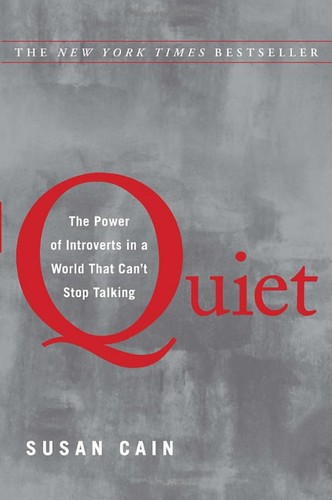
The Power of Introverts in a World That Can't Stop Talking
by Susan Cain
- Introversion
- Introverts
- Extraversion
- Interpersonal Relations
As an Amazon Associate, Home of a Book Lover earns from qualifying purchases. Book data from Open Library.
Quick facts
| Subtitle | The Power of Introverts in a World That Can't Stop Talking |
|---|---|
| Author | Susan Cain |
| First published | 2012 |
| Edition publisher | Crown Publishers |
| Edition date | January 24, 2012 |
| Language | English |
| Pages (this edition) | 333 |
| ISBN-13 | 9780307352149 |
| ISBN-10 | 0307352145 |
| Formats | hardcover |
| Subjects | Introversion, Introverts, Extraversion, Interpersonal Relations |
About Quiet
Former corporate lawyer Susan Cain argues that Western, and especially American, culture undervalues introverts because of an "Extrovert Ideal": the belief that the ideal self is gregarious and comfortable in the spotlight. She traces that ideal to a 20th-century shift from a culture of character to a culture of personality, examines the biology of temperament, questions open-plan collaboration and brainstorming, and ends with advice on relationships between opposite types and on raising quiet children. Cain defines introverts largely by their preference for less stimulating environments. Drawing on biology, psychology, neuroscience and evolution, Cain argues that introversion is both common and normal, and she urges changes in workplaces, schools and parenting.
Main themes
- The Extrovert Ideal and its historical roots
- Temperament and biology
- Work and creativity, including a critique of the "New Groupthink"
- Acting out of character for things that matter (Brian Little's Free Trait Theory)
Key concepts
- Extrovert Ideal
- culture of character vs. culture of personality
- New Groupthink
- Free Trait Theory
- restorative niches
- high reactivity
Who it’s for
Who should read it
Introverts who have felt pressured to perform extroversion, managers designing teams and workspaces, and teachers and parents of quiet children.
Who may not enjoy it
Readers wanting a rigorous scientific treatment; reviewers have described it as part affirmation, part social commentary and part self-help rather than strict popular science.
What makes it distinctive
It combines cultural history, psychology and workplace critique into an argument that is as much about institutions as about individuals.
Style & difficulty
Easy. Narrative reporting with research summaries; four parts with self-contained chapters.
Context
Published by Crown on January 24, 2012 after seven years in the making. Cain studied at Princeton and Harvard Law School and later co-founded Quiet Revolution. Some reviewers faulted its generalizations about East Asian cultures in the chapter on Asian-American students.
Strengths & limitations
Strengths
- Validating for introverted readers while still evidence-informed
- Useful critique of meeting-heavy, open-plan work cultures
- Practical chapters on relationships and parenting
Limitations
- Generalizations about cultures drew criticism
- Introvert–extrovert framing can feel binary despite the book's nuance
FAQs
Does Quiet say introverts are better than extroverts?
No. Cain adopts the definition of introversion and extroversion as preferences for different levels of stimulation and outlines advantages and disadvantages of each. Her complaint is with a culture that treats one temperament as the ideal, which she calls a colossal waste of talent, energy and happiness.
Sources & attribution
- Edition: Crown Publishers 2012 first edition hardcover, ISBN 9780307352149, x + 333 pages; TOC four parts incl. 'Soft power: Asian-Americans and the extrovert ideal' and 'On cobblers and generals: how to cultivate quiet kids' — openlibrary.org
- ISBN-10 0307352145 derived from ISBN-13 (same edition) — openlibrary.org
- Extrovert Ideal; highly reactive infants more likely to become introverts; culture of character to culture of personality (Warren Susman); New Groupthink; Free Trait Theory of Brian Little and restorative niches; introvert defined by preference for less stimulating environment — en.wikipedia.org
- Published January 24, 2012; seven years in the making; Cain former Wall Street lawyer — en.wikipedia.org
- Reception: 'part affirmation, part social commentary, part self-help primer' (Harvard Independent); criticism of generalizations about East Asian cultures — en.wikipedia.org
- Cain: Princeton, Harvard Law School; co-founded Quiet Revolution (2015) — en.wikipedia.org
- Cover image matches work (visually checked) — covers.openlibrary.org
- Cites biology, psychology, neuroscience, evolution; introversion common and normal; urges changes at workplace, schools, parenting — en.wikipedia.org
- Preferences for different levels of stimulation; advantages and disadvantages of each temperament; 'a colossal waste of talent, energy, and happiness' — en.wikipedia.org
Book data from Open Library.
Listen: find the audiobook As an Amazon Associate we earn from qualifying purchases.