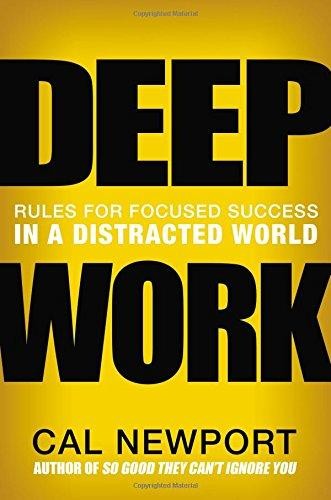
Rules for Focused Success in a Distracted World
by Cal Newport
- Attention
- Distraction (psychology)
- Time Management
- Performance
As an Amazon Associate, Home of a Book Lover earns from qualifying purchases. Book data from Open Library.
Quick facts
| Subtitle | Rules for Focused Success in a Distracted World |
|---|---|
| Author | Cal Newport |
| First published | 2016 |
| Edition publisher | Grand Central Publishing |
| Edition date | January 5, 2016 |
| Language | English |
| Pages (this edition) | 304 |
| ISBN-13 | 9781455586691 |
| ISBN-10 | 1455586692 |
| Subjects | Attention, Distraction (psychology), Time Management, Performance |
About Deep Work
Cal Newport, a computer science professor at Georgetown, defines deep work as focused, distraction-free effort on cognitively demanding tasks, and argues it is becoming both more valuable and more rare in an economy saturated with email and social media. The book is split in two. Part one makes the case in three chapters: deep work is valuable, deep work is rare, deep work is meaningful. Part two offers four rules for building the capacity: work deeply, embrace boredom, quit social media, and drain the shallows.
Main themes
- The economic case for sustained concentration
- Training attention, including tolerating boredom
- Selective technology use instead of default adoption
- Shrinking shallow work such as reflexive email
Key concepts
- deep work vs. shallow work
- deep work as valuable, rare and meaningful
- working deeply
- embracing boredom
- quitting social media
- draining the shallows
Who it’s for
Who should read it
Knowledge workers, researchers, writers, programmers and students who feel their attention fragmented by messaging and meetings.
Who may not enjoy it
Readers with little control over their schedules, such as many frontline or on-call roles, may find several rules hard to apply as written.
What makes it distinctive
It treats focus as a trainable professional skill with economic value, and pairs that argument with firm, sometimes contrarian rules, including the suggestion that many professionals should quit social media.
Style & difficulty
Easy to moderate. Argument plus prescriptive rules, illustrated with stories such as Carl Jung building a stone tower in the woods to focus his mind.
Context
Published by Grand Central Publishing on January 5, 2016. Newport earned a PhD in computer science at MIT and joined Georgetown in 2011; he later extended the argument in Digital Minimalism (2019), A World Without Email (2021) and Slow Productivity (2024).
Strengths & limitations
Strengths
- Clear thesis and concrete rules
- Speaks directly to modern knowledge-work conditions
- Pairs cultural critique with practice
Limitations
- Assumes a degree of autonomy many workers lack
- Leans on examples of unusual individuals and settings
FAQs
Where does the term 'deep work' come from?
The phrase had earlier psychological and religious uses, but Newport gave it its current meaning in this book: focused chunks of time on intellectually demanding tasks, free of distractions such as email and social media.
What did Newport write after Deep Work?
He extended the argument in Digital Minimalism (2019), A World Without Email (2021) and Slow Productivity (2024). Since 2021 he has also used the phrase 'the hyperactive hive mind' for the role constant email and chat play in work.
Sources & attribution
- Edition: Grand Central Publishing 2016, ISBN 1455586692 / 9781455586691; TOC Part 1 The Idea (Deep Work Is Valuable/Rare/Meaningful), Part 2 The Rules (Work Deeply, Embrace Boredom, Quit Social Media, Drain the Shallows) — openlibrary.org
- Publisher: on sale Jan 5, 2016; 304 pages; Grand Central Publishing — hachettebookgroup.com
- Deep work definition: focus without distraction on a cognitively demanding task; suggests most serious professionals should quit social media; Carl Jung stone tower example (publisher description in OL record) — openlibrary.org
- Newport: Georgetown CS professor, MIT PhD 2009, joined Georgetown 2011; later books Digital Minimalism 2019, A World Without Email 2021, Slow Productivity 2024 — en.wikipedia.org
- Cover image matches work (visually checked) — covers.openlibrary.org
- Term deep work previously used in psychological/religious sense; Newport's usage; challenges belief that social media matters for career capital; 'hyperactive hive mind' (2021) — en.wikipedia.org
Book data from Open Library.